Monday, October 21, 2013

Giving Students the Freedom to Fly


Last week I took a leap of faith. If I give students freedom they will rise to the occasion. 

 At the conclusion of a unit on flight forces in my second year applied physics course, I had to give an assessment to meet grade requirements. So I did. Up until now, major grades have been based on projects, but I needed an additional major grade. Multiple choice tests were thrown out last year as they do not apply to the course any longer. I have heard of other teachers giving alternative assessments and had the opportunity to talk with them, but never have given one that was entirely up to the student to create. Students have the choice of how they will examine and analyze topics and how they will meet challenges. It makes sense to give them choice in how they show what they have learned. 

At the start of the unit students were given the rubric for the assessment in hopes that they would think about it as they went through the lessons and activities. The assessment was basically “prove to me you learned something about flight and forces” with 35% air resistance, 35% flight forces and 30% student choice. To get full credit for an objective students had to show understanding of the topic, apply it to the class activities and extend it to an additional example of air resistance or flight. The student choice portion was the most difficult for me to explain. They wanted more than “prove to me you learned something about flight and forces” in a way that showcases your skills and understanding. I did not want to give them too many rules as I wanted to see what they could do given the opportunity. 

After the final activity in the unit, students were given 2 class periods to create, write, talk, or otherwise show what they learned in their terms with their skills and interests. Some chose the interview route and the conversations were very telling. It was easy to tell what the student had just read from a web site and what they really understood. Some needed to go step by step and be told how many points they had earned so far, surprisingly none of them was content until they had earned all of the possible points. Others extended the labs and did more experimenting, built biplanes out of straws, calculated drag for different sized parachutes. Some tied air resistance to motion in water and others talked about the lack of air resistance in space.  Some analyzed the different parts of an airplane to see how each changed the flight of the plane. A few made connections between flight and car racing. One student animated a flying flour sack based on the behavior of the parachutes and paper helicopters he built and observed. So many ways to prove they learned. And prove it they did.

Projects are still coming in, but this may have been one of the best assessments of learning I have given to students. Students were enthusiastically showing me what they learned in their words with their experience and in the context of what was meaningful to them.  Next time my rubric will provide more guidance and clearer expectations without adding boundaries. I expect even better results when I try this again.

Sunday, October 6, 2013

More Standards: An Easy Fit or So Many, So Little Time?


http://www.slipperybrick.com/wp-content/uploads/2008/04/rubi.jpg
Rubik's Cube Alarm Clock
As a Texas teacher my curriculum is defined by the Texas Essential Knowledge  and Skills (TEKS). There is a set for physics and a set for scientific research and design (SRD). Every lesson is driven by these standards. The National Association of Science Teachers has another set of standards for physics and SRD as part of their Next Generation Science Standards (NGSS). Even though science is not currently part of the Common Core Standards (CSS) and Texas will probably not adopt the standards, they cannot be dismissed as students may plan to leave Texas for universities and employment. Through my course work, I have recently been introduced to yet another set of learning standards, The National Educational Standards for Students (NETS-S) developed by the International Society for Technology Education (ISTE). I appreciate all of these groups helping me know what students should be accomplishing during class time. Their guidance is welcome but overwhelming when the volume of standards is compared to the available class time. Focusing on the NETS-S, when examining the class activities that already exist and meet the TEKS, I find that in many lessons the NETS-S are already being met, or can be met by including  web 2.0 tools to the lesson.

One standard addresses student creativity, critical thinking and problem solving (NETS-S, 2007).  The creativity of thought includes the use of models and simulations to solve problems. For physics students the free Phet site gives students the opportunity to perform virtual inquiry labs that would not be possible in the classroom due to size, cost or danger. The Physics Classroom also offers a wide range of simulations that students can explore to gain understanding regarding difficult concepts. A web search for simulations will produce a long list of site to explore. 

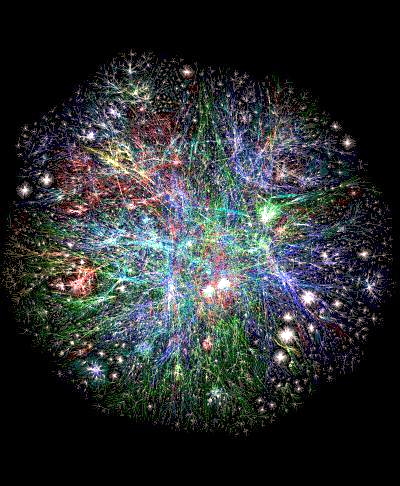
3D Map of the World Wide Web
The requirement for students to communicate, collaborate, conduct research and use creativity can be addressed with a number of web tools (NETS-S, 2007).  Web 2.0 tools such as showme.com (for Apple products) or the many options available through Google documents can be used to communicate results from an experiment. Currently in SRD, some students have chosen to track and share their learning for a year-long project in blogs. Additionally, Google documents offers easy collaboration tools by allowing document sharing, comments, voice comments and chats. Students should be encouraged to go beyond Wikipedia  and use sites such as Encyclopedia Britannica and other encyclopedias which are also available online for research. Additional sources are available through schools and local libraries. Collaborative research can be collected in sites such as diigo.com. Students share results and show their creativity with larger projects using tools such as prezi.com or voicethread.com. It takes some creativity on the part of the teacher to move the products of science lessons beyond data tables, graphs and conclusions written on paper, but the tools are available for those who are willing.

The standards of good digital citizenship and correct technology can be taught and modeled in any lesson that includes technology (NETS-S, 2007). Expectations for the use of technology in the classroom must be clear to the students. The difference between their informal use and the formal use should be explained as the same tool may be used by the student in a different setting. Modeling these standards in the lessons they create will help student understand digital citizenship and how to correctly use the technology tools they are learning. 

There are plenty of web tools available for students to create, problem solve, collaborate and learn. Teacher creativity and knowledge as well as the availability of reliable, connected computers in the classroom make the difference in the ability to incorporate the NETS-S on a daily basis. Blocked sites and internet safety are an additional concern when introducing students to the learning opportunities available on the World Wide Web. All things considered, I am happy to discover that overall the standards in NETS-S can be met in my classroom along with the course TEKS for physics and SRD.


Texas Essential Knowledge and Skills (2013). Retrieved October 6, 2103 from http://www.tea.state.tx.us/index2.aspx?id=6148
 
High School Physical. Science Next Generation Science Standards (April 2013). Retrieved October 6, 2013 from http://nstahosted.org/pdfs/ngss/20130509/dci-grouped/HS-PhysicalScienceStandards.pdf

Common Core State Standards Initiative (2012). Retrieved October 6, 2013 from http://www.corestandards.org/

NETS for Students 2007 (2007). Retrieved October 6, 2013 from http://www.iste.org/standards/nets-for-students/nets-student-standards-2007

Laughead, G. (2009, February 25). 3D Map of the World Wide Web Retrieved October 6, 2013 from http://www.vlib.us/web/worldwideweb3d.html